 How-to
Does the 25% Roof Replacement Rule Apply to You?
Last Updated: October 25, 2026
Quick Summary
The 25% roof replacement rule in Florida is a building code provision: once repairs exceed 25 percent of the total roof area within any 12-month period, the entire roof covering must be replaced. It is a building code requirement, not an insurance rule, and the building official applies it at permit review.
- The rule traces back to the Florida Building Code, most often the 2007 edition.
- Senate Bill 2D, passed in March 2009, created an exception for newer homes and code-compliant roofs.
- Divide damaged roof area by total roof area and multiply by 100 to get the damage percentage.
- The 12-month period is a rolling window, so prior repairs count toward the 25 percent total.
- Law and ordinance coverage may bridge the gap between code requirements and what your policy pays.
Table of Contents
- What the 25% Roof Replacement Rule Actually Says
- How to Calculate Roof Damage Percentage on Your Roof
- Roof Area vs Roof Section: Why the Distinction Decides Your Project
- When Repairs Can Exceed 25% and When a Whole Section Must Go
- Florida Roof Replacement Requirements for Newer and Code-Compliant Roofs
- Florida Homeowners Insurance Roof Requirements vs Building Code
- Permits, Inspections, and the 12-Month Measurement Period
- Get a Damage Assessment From Florida Exterior-Interior Contracting
- Frequently Asked Questions
What the 25% Roof Replacement Rule Actually Says
The 25% roof replacement rule in Florida is a building code provision: once repairs exceed 25 percent of the total roof area within any 12-month period, the entire roof covering must be replaced.
Here is the part most people get wrong: the rule is a building code requirement, not an insurance rule. It tells a contractor and a local building official what work is legally allowed, not what your insurer must pay for.
The Florida Building Code Wording and the 2007 Edition
The provision traces back to the Florida Building Code, most often the 2007 Florida Building Code. It ties roof replacement to the roof covering over the existing building: when more than 25 percent of the roof covering is repaired, replaced, or recovered in a 12-month window, the whole roof covering must meet current code.
That wording matters because it is specific about three things:
- It applies to the roof covering, meaning the shingles, tiles, or membrane on top, not the deck or framing underneath.
- It is triggered by repair volume, measured against the roof area.
- It runs on a rolling 12-month period, not a calendar year.
Read the code text carefully before you accept any contractor's interpretation, the exact language is what a building official will apply when reviewing a permit.
What Senate Bill 2D Changed in March 2009
Senate Bill 2D, passed in March 2009, created an exception for certain newer homes and roofs that already met code. A roof permitted and built to a qualifying code edition, or already brought into compliance, can sometimes be repaired past the threshold without a mandated full replacement. Confirm your home's construction date and permit history before assuming the exception applies.
Here are the core facts about the rule at a glance.
| Item | Value | Note |
|---|---|---|
| Repair threshold | More than 25 percent of total roof area | Triggers full roof covering replacement |
| Measurement period | Any 12-month period | Rolling window, not a calendar year |
| What it covers | The roof covering | Shingles, tiles, or membrane, not deck or framing |
| Code source | Florida Building Code | Most often the 2007 edition |
| Exception created | Senate Bill 2D, March 2009 | For newer homes and code-compliant roofs |
| Who applies it | The building official | Reviews the scope at permit |
| Nature of rule | Building code requirement | Not an insurance rule |
How to Calculate Roof Damage Percentage on Your Roof
To calculate the damage percentage, divide the damaged roof area by the total roof area, then multiply by 100. A roof with 400 square feet of damage on a 2,000-square-foot roof sits at 20 percent, under the threshold.
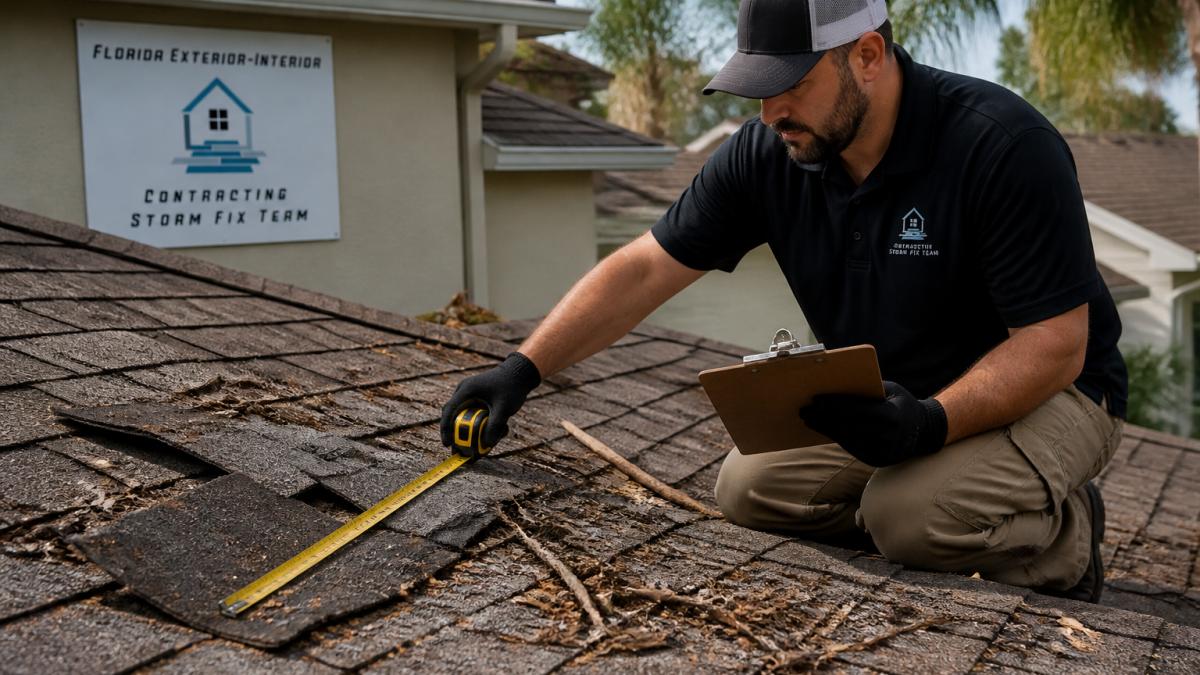
Here is how the math works in practice:
- Measure the total roof area in square feet, using the full footprint including slopes.
- Measure the damaged area that needs repair or replacement.
- Divide damaged area by total area and multiply by 100.
- Compare the result to the 25 percent threshold.
A common mistake is eyeballing damage from the ground. Storm damage hides under shingle layers, and a slope that looks fine can be compromised at the deck.
How to Measure the Affected Roof Area
Measuring the affected area is where most homeowners and even some contractors get into trouble. The 25 percent threshold is based on the roof covering area, not the footprint of the house, measure the sloped surface, not the floor plan.
A practical approach:
- Break the roof into measurable planes. Each distinct slope or facet is measured separately, then added together for the total roof area.
- Use the actual dimensions of each plane, including overhangs and dormers, because the roof covering extends over them.
- Measure the damaged area on the same basis. If damage covers half of a 400-square-foot plane, that is 200 square feet of affected roof area.
Most roofing contractors use aerial measurement reports or field measurements to establish total roof area, then mark damaged zones on the same plan. Ask for that documentation in writing.
Defining a Roof Section
The code also refers to an entire roof section, and how you define a section can change the scope of required work.
Why the definition matters:
- If damage is concentrated within one defined section, the requirement can apply to that whole section even when it is a smaller share of the total roof area.
- If damage is spread across multiple sections, the 25 percent calculation is applied against the total roof area, but each affected section may still need to be brought into compliance.
- Local building officials may interpret section boundaries differently, so confirm how your jurisdiction defines a section before finalizing scope.
A common pattern: storm damage isolated to the windward side of a multi-plane roof. That plane might be only 15 percent of the total roof area, but if treated as one section, the repair scope can expand to the full plane.
A Worked Example
Consider a 2,400-square-foot roof covering made up of four planes of roughly 600 square feet each. A storm damages 200 square feet on one plane and 100 square feet on another.
- Total damaged area: 300 square feet.
- Percentage of total roof area: 300 ÷ 2,400 = 12.5 percent, below the 25 percent threshold.
- But the 200 square feet on the first plane is one-third of that 600-square-foot section, and the 100 square feet on the second plane is one-sixth of its section.
Whether a full section replacement is required depends on how the building official applies the section rule and the condition of the existing roof covering. The math alone does not decide the outcome; the code edition and local interpretation do.
Documentation to Keep
Keep a simple file for every roof repair:
- Date of repair and contractor name.
- Photos of damage before repair.
- Measured area of damage and the roof plan used.
Because the threshold runs on a rolling 12-month period, prior repairs count toward the total. Homeowners who keep this record avoid surprises when a second repair pushes them over the line.
Roof Area vs Roof Section: Why the Distinction Decides Your Project
The difference between roof area and a roof section decides whether you face a partial repair or a full replacement. The 25 percent threshold is measured against total roof area, but if a single defined section needs work, the requirement can apply to that whole section even when it is a smaller share of the total, which is where an honest damage assessment beats a guess every time.
When Repairs Can Exceed 25% and When a Whole Section Must Go
Repairs can exceed 25 percent without triggering a full replacement when the roof qualifies for the newer-home or code-compliant exception described above, the partial repair can proceed if the roof already meets the applicable code requirements. A whole section must go when the damage within it is substantial enough that patching would leave a code-deficient roof; the building official reviewing the permit makes that call.
For quick answers to the follow-up questions homeowners ask most, our roofing questions answered page covers the details.
Florida Roof Replacement Requirements for Newer and Code-Compliant Roofs
Florida roof replacement requirements ease for homes whose roofs already meet current code. If your roof was installed under a qualifying code edition and has not been compromised, the 25 percent trigger may not force a full replacement. Check the home construction date, the code edition in force at that time, and current roof condition, including deck integrity and underlayment age.
Florida Homeowners Insurance Roof Requirements vs Building Code
Florida homeowners insurance roof requirements are not the same as the building code. The code sets what work is legally required. Your insurance claim sets what your policy will pay for, and those two can diverge sharply.
A replacement cost policy may cover the peril that caused the roof damage, but it will not automatically pay to bring the whole roof up to current code just because the 25 percent rule applies. For a deeper look at why carriers push back on roof claims, see our guide on why homeowners insurance denies roof claims.
Permits, Inspections, and the 12-Month Measurement Period
A permit and an inspection are where the 25 percent rule becomes real. The 12-month period is a rolling window, so repeated small repairs can add up and cross the threshold even when no single job did.
The process generally runs like this:
- The roofing contractor documents the damaged area and defines the roof section.
- You or the contractor pull a permit for the roofing work.
- The building official reviews the scope against the code edition.
- An inspection confirms the work meets code requirements.
- The final scope is approved, repair or replacement.
Keep records of every repair, prior work within a year counts toward the 25 percent total.
Who to Contact and What to Bring
Permits for roof repairs and replacements are issued by your local building department, which may be a city or county office. The building official or a plans examiner reviews the application. In most jurisdictions, the contractor pulls the permit, but the homeowner is ultimately responsible for ensuring one exists.
Documents commonly requested with a roofing permit application:
- Scope of work describing the repair or replacement, including whether the full roof covering or a section is being replaced.
- Roof plan or sketch with dimensions showing total roof area and the affected area.
- Product approval numbers for the roofing materials, since roofing products used in the state must meet applicable product approval requirements.
Requirements vary by jurisdiction, so call the building department before submitting, a five-minute call saves a rejected application and a delay.
How the 12-Month Window Is Applied
The 12-month period is a rolling window, not a calendar year: a repair completed in March counts against repairs through the following February. Repair 15 percent of the roof in the spring and another 15 percent in the fall, and the combined 30 percent crosses the threshold even though each job was under 25 percent on its own.
A practical pattern many contractors follow:
- Track the cumulative repaired area, not just the current job.
- Note the date of each repair so the rolling window can be calculated.
- Flag any repair that would push the cumulative total over 25 percent before work begins.
What the Inspection Covers
A roofing inspection typically verifies that the work matches the permitted scope and that materials and installation meet code. For a partial repair, the inspector may check that the repaired area ties into the existing roof covering correctly and that the underlying deck is sound where exposed; for a full replacement, the inspection covers the entire roof covering installation. If the inspection reveals the scope should have triggered a full replacement, the permit may be revised and additional work required, so settle measurement and section definition before the permit is issued.
Verifying Current Requirements
Building codes change, and local amendments can affect how the 25 percent rule is applied. Before relying on any summary, including this one: check the current Florida Building Code edition in effect for your jurisdiction, contact your local building official for the department's interpretation of roof section and repair thresholds, and ask your contractor for the code edition and product approvals that apply.
Get a Damage Assessment From Florida Exterior-Interior Contracting
The 25 percent rule rewards clarity, and clarity starts with an accurate measurement. Our veteran-owned team provides direct owner oversight, bilingual service in English and Spanish, and certified roofing professionals who document the damaged area and the roof section before recommending repair or replacement.
If you need a straight answer on your roof, get your instant quote and we will assess the damage and walk you through your options.
Frequently Asked Questions
Does the 25% roof replacement rule require a full roof replacement?
Not automatically. The rule is triggered when more than 25% of a roof section needs repair or replacement within any 12-month period. If the damaged area stays under that threshold, a partial repair can be permitted. Once the affected area crosses 25%, the entire roof section must be brought up to current code, and in some cases the whole roof covering must be replaced. A building official makes the final call after inspecting the roof and reviewing the permit application.
How do you calculate whether roof damage exceeds 25%?
Measure the square footage of the damaged area, then divide it by the square footage of the roof section it sits on. If the result is above 0.25, the threshold is exceeded. The tricky part is defining the roof section: a section is a continuous plane of roof covering bounded by hips, valleys, ridges, or edges, not the entire roof. A roofing contractor can map the sections and give you the percentage in writing before you file a permit.
Do Florida homeowners insurance roof requirements differ from the 25% rule?
Yes, and the two are often confused. The 25% rule is a building code obligation that governs how much repair work can be permitted before the whole section must be upgraded. Insurance is a separate contract: your policy, replacement cost coverage, law and ordinance coverage, and deductible decide what the insurer pays. A roof can trigger the code rule without an insurance claim, and an insurance payout does not override the building code.
Does the 25% rule apply to roof repairs or only to replacement?
It applies to repairs. The rule is triggered by the amount of roof covering being repaired or replaced, so a repair permit that covers more than 25% of a roof section within 12 months forces the whole section to be replaced. Small repairs under the threshold can usually proceed as repairs. Because the 12-month period is cumulative, several small repairs in the same section can add up and cross the line.
The 25 percent rule does not have to be a guessing game. Get a measured, code-based assessment from Florida Exterior-Interior Contracting, with certified professionals, clear communication, and owner oversight on every project. Get started with Florida Exterior-Interior Contracting and know exactly what your roof needs.