 Ultimate guide
Repair or Replace Storm Damaged Roof: A Homeowner's Guide
Last Updated: October 26, 2026
Quick Summary
Deciding whether to repair or replace a storm damaged roof comes down to four factors: the extent of damage, roof age, material, and what insurance covers. Isolated damage on a roof with life left is usually repairable, while widespread damage or a roof near the end of its lifespan points to replacement.
- Weigh extent first: a few missing shingles on one slope is a repair conversation.
- Dented soft metals like gutter aprons and vent caps are a reliable hail indicator.
- A repair costing $1,200 that buys three years works out to roughly $400 per year.
- If three or more inputs point toward replacement, full replacement is usually the more honest recommendation.
- Patching a roof can void or limit the manufacturer's warranty on surrounding shingles.
Table of Contents
- Repair vs. Replace: The Decision Framework for a Storm Damaged Roof
- Signs of Roof Storm Damage You Can Spot From the Ground
- Why a Roof Inspection After a Storm Comes Before Any Repair Decision
- Hidden Damage and Secondary Risks Most Homeowners Miss
- How a Homeowners Insurance Roof Storm Damage Claim Works
- Storm Damage Roof Repair Cost vs. Replacement Lifecycle Cost
- When Isolated Damage Can Be Repaired and When Widespread Damage Means Replacement
- Get Your Storm Damaged Roof Assessed by a Local Crew
- Frequently Asked Questions
Repair vs. Replace: The Decision Framework for a Storm Damaged Roof
When a storm passes and you're staring at a damaged roof, the question isn't whether to act, it's whether your insurance company will pay to repair the damage or replace the whole roof.
A storm damaged roof is any roof that has lost shingles, granules, flashing integrity, or decking soundness due to hail, wind, or falling debris. The repair-or-replace decision hinges on how much of the roof is affected and how much useful life remains.
The Four Factors That Decide It: Extent, Age, Material, and Insurance
Four factors carry almost all the weight in a repair-or-replace decision:
- Extent: Is damage confined to one slope or spread across multiple elevations?
- Age: How much service life does the roof have left relative to its expected lifespan?
- Material: Asphalt shingles, tile, and metal each have different repair thresholds.
Weigh extent first. A few missing shingles on one slope after wind is a repair conversation. Granule loss across every slope after hail is a replacement conversation. Age comes second: a roof near the end of its service life rarely justifies a large repair investment, because you'll pay twice.
Signs of Roof Storm Damage You Can Spot From the Ground
Most storm damage is visible from the ground with binoculars, no ladder required. Look for these specific signs of roof storm damage:
- Missing, lifted, or creased shingles, especially on windward slopes
- Cracked shingles or exposed nail heads after hail
- Granule accumulation in gutters and at downspout outlets
Dented soft metals, like gutter aprons and vent caps, are frequently the clearest evidence that shingles took an impact too.
Why a Roof Inspection After a Storm Comes Before Any Repair Decision
A roof inspection after a storm is the step that converts guesswork into a documented decision. A professional walks the roof, checks shingle integrity, flashing, and decking, photographs the damage, and separates cosmetic wear from storm-caused failure.
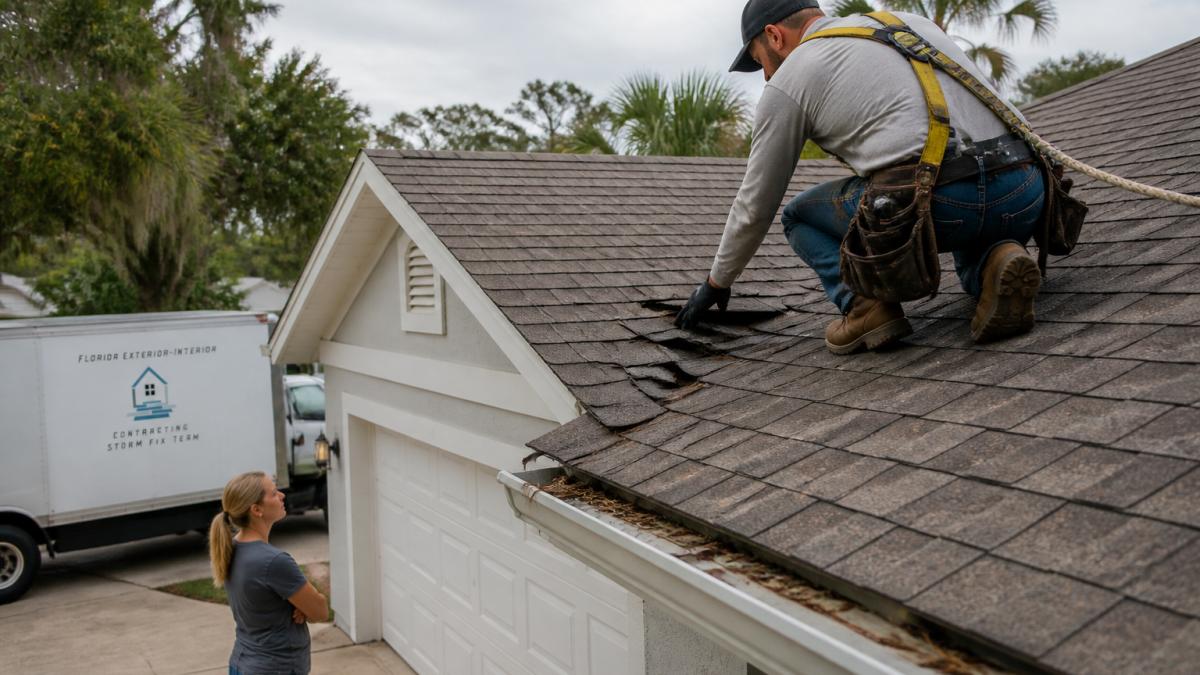
Watch out: climbing a storm-damaged roof yourself is the most common way homeowners turn a covered claim into an uncovered injury. If you have questions about what an inspection involves, our roofing FAQ page answers the most common ones.
Hidden Damage and Secondary Risks Most Homeowners Miss
Hidden damage is where repair-or-replace decisions go wrong. What looks like a cosmetic issue on top can hide:
- Compromised flashing around chimneys and valleys, letting water intrude behind siding
- Saturated underlayment that no longer sheds water even after shingles are patched
- Soft or delaminated roof decking that can't hold new fasteners
A common mistake is patching the visible shingle damage and skipping the attic inspection. Water intrusion rarely announces itself. By the time a ceiling stain appears, the decking underneath has often been wet long enough to need replacement, not repair.
How a Homeowners Insurance Roof Storm Damage Claim Works
A homeowners insurance roof storm damage claim follows a predictable path: report the damage promptly, schedule the adjuster's inspection, document everything, and review the adjuster's scope against your contractor's assessment.
Claim documentation matters more than most homeowners expect. Why homeowners insurance denies roof claims explains the common pitfalls so you can avoid them. Keep dated damage photos, your contractor's written inspection report, and receipts for any emergency tarping.
Storm Damage Roof Repair Cost vs. Replacement Lifecycle Cost
Storm damage roof repair cost is almost always lower upfront than replacement, but the cheaper option isn't always the better value. The right comparison isn't repair price versus replacement price, it's the total cost of each path over the remaining life of the roof. That means weighing the immediate bill against expected service life, the likelihood of repeat repairs, energy performance, and warranty coverage.
The lifecycle math, in plain terms
A useful way to frame it is cost per remaining year of service. If a repair costs $1,200 and buys you three more years before the next problem, that's roughly $400 per year of service. If a replacement costs $14,000 and delivers 25 years, that's about $560 per year, but with no repeat-repair risk, a fresh warranty, and better energy performance.
What each path actually includes
| Cost factor | Repair | Replacement |
|---|---|---|
| Typical upfront range | $400-$2,500 for isolated damage | $9,000-$25,000+ depending on size, pitch, and material |
| Service life gained | Months to a few years | Full expected lifespan of the new system (often 20-50 years depending on material) |
| Repeat-repair risk | Higher if hidden damage exists | Low; system is new and under warranty |
| Warranty | Usually limited or none on a patch | Manufacturer material warranty plus workmanship warranty |
| Energy impact | Neutral | Possible improvement with ventilation and reflective or insulated options |
| Insurance fit | Often below deductible, paid out of pocket | Larger covered claims after deductible and depreciation |
Pricing varies widely by region, roof size, pitch, material, and code requirements, which is why a written scope beats a phone estimate.
The hidden line items
Two costs rarely show up in a repair quote but change the math:
- Repeat repairs. Each patch is a new mobilization, and a second or third repair on the same roof often erases the savings from choosing repair over replacement.
- Warranty voiding. Patching a roof can void or limit the manufacturer's warranty on the surrounding shingles, especially if the patch uses mismatched materials or improper fasteners.
How insurance changes the comparison
Insurance rarely pays the full replacement price. Expect your deductible, and on older roofs, depreciation that reduces the initial payout until recoverable depreciation is released after the work is complete. That means the out-of-pocket gap between repair and replacement is often smaller than the sticker prices suggest, and sometimes the replacement is the better value once the deductible is applied to a claim you'd file anyway.
Pricing varies by roof size, pitch, and material, so we quote each roof individually rather than publish numbers that won't match yours.
When Isolated Damage Can Be Repaired and When Widespread Damage Means Replacement
Isolated damage is repairable when it's confined to a small area, the surrounding shingles are sound, and the roof has meaningful service life remaining. Widespread damage means replacement: when hail or wind has affected multiple slopes, granule loss is uniform, or the decking shows soft spots across the field of the roof. The tricky part is that "isolated" and "widespread" look different depending on what your roof is made of, and the material determines whether a patch will actually hold.
A practical first-pass decision framework
Before any contractor walks the roof, you can make a rough first assessment using four inputs. This isn't a substitute for an inspection, but it tells you which conversation you're likely to have.
| Input | Points toward repair | Points toward replacement |
|---|---|---|
| Damage extent | One slope or a small area; surrounding material sound | Multiple slopes or elevations; uniform granule loss or impact pattern |
| Roof age | Well within expected lifespan | Near or past expected lifespan |
| Material condition | Flexible, intact, matching replacement pieces available | Brittle, granule-depleted, or discontinued material |
| Repair history | No prior patches in the area | Repeated repairs on the same roof |
If three or more inputs point toward replacement, a full replacement is usually the more honest recommendation. Craftsmanship That Covers You shows completed re-roofing results for homeowners in and around Orlando.
How repairability differs by material
Here's how the thresholds actually differ:
- Asphalt shingles. The most repairable common roof. Localized wind or hail damage can be patched with matching shingles if the surrounding field is sound and the shingles aren't brittle from age. The catch: color and profile matching gets harder as the roof ages, and a patch on a granule-depleted roof often fails at the seams.
- Metal roofs. Repairable in sections when the panels are still sound and the fasteners and sealants are serviceable. Exposed-fastener panels are easier to repair than standing-seam systems, which usually require a contractor familiar with the specific profile. Mismatched panels can compromise the assembly and void warranties.
- Tile roofs. Often repairable piece-by-piece when the underlayment is intact, but tile is brittle and walking it causes breakage. The real question is the underlayment beneath: if it's near the end of its life, replacing tiles without addressing it is wasted money.
The hidden-damage check that decides it
Extent on the surface is only half the answer. Before committing to a repair, the inspection should confirm that the underlayment, flashing, and decking beneath the damaged area are sound. A patch over saturated underlayment or soft decking will fail, often within a season, and you'll have paid for the repair and the replacement.
Get Your Storm Damaged Roof Assessed by a Local Crew
The challenge with storm damage is that the honest answer, repair or replace, depends on evidence you can't gather from the driveway. That's the gap we close. At Florida Exterior-Interior Contracting, we're a veteran-owned, bilingual team with over a decade of hands-on experience, and the owner stays involved from assessment through completion. We also offer financing for those who qualify, so a full replacement doesn't have to wait. Get Started and get a straight answer from a local crew.
Frequently Asked Questions
Should I repair or replace my roof after storm damage?
It depends on how much of the roof is affected, its age, and its condition before the storm. Isolated damage on a younger roof, such as a few missing shingles or a damaged flashing section, usually can be repaired. Widespread damage, granule loss across large areas, or a roof near the end of its service life points toward replacement. A professional inspection after the storm is the only reliable way to tell the difference, because much of the damage is not visible from the ground.
How do I know if a storm damaged my roof?
Common signs of roof storm damage include missing, cracked, or lifted shingles, granule loss in gutters and downspouts, dented metal flashing or vents, and dark spots on ceilings or walls. After a hail or wind event, check the ground for shingle pieces and look at the roof from a safe distance. Water stains in the attic and daylight showing through the roof deck are stronger signals. Any of these warrants a professional inspection rather than a wait-and-see approach.
Will homeowners insurance cover storm-damaged roof repairs or replacement?
Most standard homeowners insurance policies cover sudden storm damage, such as wind or hail, subject to your deductible and policy terms. Wear and tear, poor maintenance, and age-related deterioration are typically excluded. Document the damage with photos before any temporary repairs, file the claim promptly, and meet the adjuster on site. If the adjuster's scope and your contractor's scope disagree, ask for a line-by-line comparison and a re-inspection rather than accepting the first number.
How much does it cost to repair storm damage to a roof?
Storm damage roof repair cost depends on the size of the affected area, the roofing material, access, and whether decking or underlayment needs replacement. Pricing depends on the size of the affected area, the roofing material, access, and whether decking or underlayment needs replacement. Because pricing changes with material and scope, request a written, itemized quote from a licensed contractor rather than relying on a general range.
Can a roof be repaired after wind or hail damage?
Yes, in many cases. Wind damage often lifts or tears shingles in specific areas, and hail can crack shingles or dent metal components. If the damage is isolated and the surrounding shingles are still pliable and well bonded, a targeted repair is a sound choice. If shingles across the roof show granule loss or cracking, patching one area leaves the rest vulnerable, and replacement becomes the more durable option. A contractor should explain which situation applies to your roof.
Can I stay in my home while my storm-damaged roof is being repaired?
For most repairs and replacements, yes. Roofing work happens above the living space, and crews typically keep the interior protected. Expect noise, some vibration, and limited driveway access while materials are staged. If the damage has allowed significant water intrusion or the decking is compromised, your contractor may recommend temporary measures or a short relocation for safety. Ask about the daily schedule and cleanup plan before work begins.
Storm damage won't get cheaper to fix by waiting, and small leaks become structural repairs fast. Get started with Florida Exterior-Interior Contracting and get a documented, honest assessment of your roof before you commit to either path.